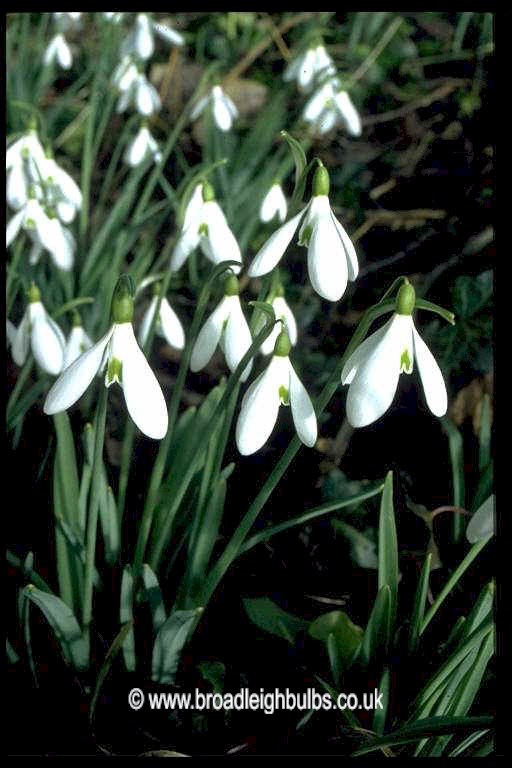
They are fully hardy and even have especially hardened tips to push through snow. However for such a popular plant they can be remarkably temperamental to grow – thriving in some soils but declining in others. If you have not tried to grow them before it is best to start with one of the easiest – G nivalis – the ‘common’ single, double or G Atkinsii, a vigorous tall variety. Once you have established these successfully then you can try one of the more unusual varieties, but be warned – you could become hooked and it is an expensive, if very rewarding hobby! You will find many fellow Galanthophiles.
Snowdrops like a moist soil with plenty of humus. They do not like hot, dry positions preferring part shade. They are good among shrubs.
How, you might ask, can there be so many different snowdrops – they all look alike to me? Let us start with the obvious differences.
a. Leaves:
There are many different species (wild) snowdrops and they have very distinct leaves.
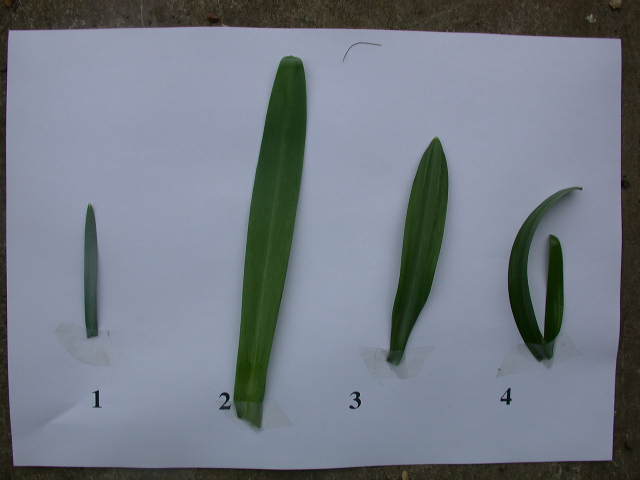
1. nivalis – the so called common snowdrop. This is not a native at all but was introduced to Britain in the 17th Century having made its way up through Europe from Italy and the Balkans. It is very vigorous and likes to grow in light woodland. Its leaves are slender, grey-green. It does not seed and must be lifted and divided to increase it. This should be done every 2 years for optimum increase.
2. elwesii – the Giant or Turkish snowdrop. As its name implies it originates in Turkey and likes a dry place in the garden – tucked at the base of a tree for instance. If it is happy it may seed. It has tall, broad grey leaves.
3. plicatus – this comes from the Crimea and is easily grown, often seeding to form large patches. Again it is good under trees where it will often seed around. Its name means folded and the leaves have 2 folds along the edges and often a silver central stripe. The leaves are very variable, from greenish-grey to blue–grey.
4. woronowii comes from the Caucasus and belongs to a group of snowdrops with green leaves.
In the wild these snowdrops do not meet but in our gardens many hybrids have occurred – hence all the names.
b. Flowers:
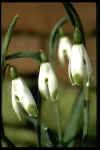
The flowers are all very similar and either single or double but the main differences are the number, location and colour of the green markings. They can be very small, very large, twin or even triple marks, sometimes on the outer petals and in rare snowdrops not green at all but yellow.
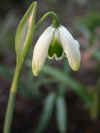
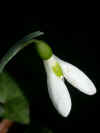
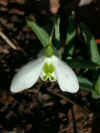
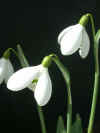
c. Size:
Some snowdrops are 9” tall, others only 5”. Likewise the flowers vary considerably in size.
d. Flowering time:
Not all snowdrops flower in the winter, there are some autumn flowering ones. These come from Greece and can be difficult in our wet climate.
SNOWDROP CARE
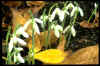
1. Avoid planting single bulbs – they are much happier in company! Small groups are best.
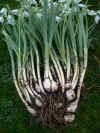
3. Make sure that neighbouring plants are not smothering the snowdrops, either with their roots or their leaves. Move the snowdrops to a new location if necessary.
4. Snowdrops can be planted either in the autumn as dormant bulbs – make sure that they are freshly lifted and not hanging around in a hot garden center as they have a very short ‘shelf’ life, or as bulbs in growth which are moved in the spring just after flowering.
5. Do not plant them in pots; they are very difficult to grow successfully like this. If it is necessary to leave them in pots for a short time – during removal etc, then use a large pot with a light, humus rich compost with some loam and plunge the pots in a shady place. Plant them out as soon as possible.
Gardens to visit to see snowdrops
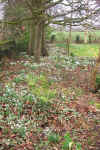
1. Broadleigh Gardens, Taunton – our collection is in a garden setting. Open Mon-Friday 9am-4pm See garden for more information.
2. Colesbourne Manor, Gloucestershire – a magnificent collection in a woodland setting.
3. Rode Hall, Scholar Green, Cheshire – A good display in a historic garden. House open.
4. Hodsock Priory, Worksop, Notts – a fantastic winter garden with a fine collection of snowdrops and other winter flowering plants.
5. Evenley Wood Garden to see Snowdrops in a wonderful Northampton woodland setting.
6. Ness Gardens, Neston Road, Neston ,South Wirral ,CH64 4AY ,TEL: 0151 353 0123
Snowdrops are listed in our Spring Catalogue (January). We sell them in growth after flowering.
Please see our Online Store for current availability.