

One has only to think of the rather limited bulbous native flora – bluebells, wild garlic, wood anemones and lent lily daffodils, which are all primarily woodlanders, to realize this. They are a perfect example of evolutionary adaptation to a cool, but wet, winter/spring followed by a cool, dry summer when the tree’s leaves not only cut out the rainfall but act as a sunshade as well. There are a host of other bulbs, both common and unusual, that will similarly take advantage of this temporary availability of light and moisture and flower here happily prior to their natural summer dormancy.
As with all plants the soil must be properly prepared in advance if the bulbs are to thrive. Whether we are talking about an ornamental cherry or a full-grown ash the approach to growing the bulbs is broadly similar. The size of the tree is not important, although under mature forest trees the area suitable for planting will only start about 1.5m from the trunk and the range of suitable subjects is more limited as the canopy effect will be more pronounced. In natural woodlands the sheer volume of leaves available for leaf mould means that the soil is naturally light with a high humus content. In the garden excessive tidiness means that most leaves are cleared away. The area should therefore be lightly dug and as much organic matter, especially leaf mould, incorporated as possible. If there are large tree roots near the surface or the soil is heavy clay then a slightly raised bed of specially prepared soil will be more successful. This is not necessary under small trees or shrubs. An annual mulch of bark or mushroom compost is beneficial, helping conserve moisture and suppressing weeds

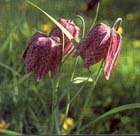
In the dappled shade of shrubs, where there is less reduction in moisture during summer, lilies can also be grown. The easiest varieties for these conditions are either the upward facing Asiatic hybrids or those with a turks cap flower such as Lilium martagon or L. lancifolium. However it must be remembered at the same time as the umbrella effect of the leaves comes into operation this ever increasing canopy needs water to maintain itself and so the root system begins to draw moisture from the surrounding ground and some supplementary watering of the lilies may be necessary during the summer particularly before they flower. Lack of water is one of the most common causes of failure to flower, both in the current and subsequent years where the there has been too little growth to produce a flowering size bulb.. Provided that the soil is not to dry and the shade excessive crocosmias can be used to extend the season through late summer. In the autumn, as the herbaceous plants begin to die back interest can be maintained by adding clumps of colchicums. Here their broad leaves, which can be a nuisance elsewhere, are an attractive bonus during the summer months.
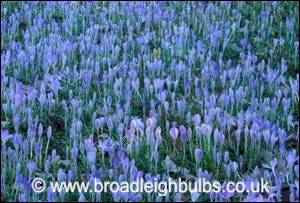
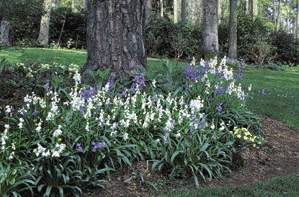
The range of bulbs suitable for planting right under the low, spreading canopy of large trees is more limited. Here the summer moisture levels are so severely reduced it is easier to concentrate on autumn and spring flowering subjects and not try to add herbaceous plants for summer interest as these will tend to be weak and add little to the display. A decorative mulch of composted bark will provide a tidy surface for the summer broken perhaps by a few drought tolerant ferns. Lilies may survive for a few seasons but they will gradually dwindle in vigour unless they are regularly watered. One plant that actively thrives these conditions is Cyclamen hederifolium which is normally grown for its attractive pink or white flowers that appear during August & September. However their domes of beautifully marbled leaves which follow the flowers are equally attractive, lasting all winter, and providing an excellent foil for other bulbs. Massed C. hederifolium can be joined in mid winter by Eranthis hyemalis and Galanthus nivalis, all of which will happily seed into each other to form a veritable carpet. These rather inhospitable conditions also suit bluebells, both the native Hyacinthioides nonscriptus and the more robust and vigorous H. hispanicus in all its colour forms. Both, along with wild garlic ( Allium ursinum) ,are really too vigorous for all but the largest areas. This caveat also applies to the delightful dwarf blue Scilla bithyinica which spreads very rapidly to carpet large areas in a sea of delicate blue spikes. It is also wonderful beneath a single small tree or large shrub such as a magnolia or Viburnum ‘Lanarth’.
Although the Mediterranean C. hederifolium relishes the dry conditions under large trees, often seeding to form large colonies, and will even tolerate the extreme drought found under conifers, C. coum will struggle to survive here. It is a plant of mixed woodlands and a more even rainfall pattern. It prefers a humus rich soil under small trees or shrubs.
There is no hard and fast rule as to what is right. It depends upon the size of both the area and the trees or shrubs above and the nature of the soil beneath. The general principal is to plant for succession bearing in mind that simple combinations of a few varieties are normally more successful than a massed muddle and above all be prepared to experiment.
Happy gardening!
See our Online Store for current availability of the bulbs mentioned in this article.
© Christine Skelmersdale, Sept 2001
An abridged version of this article appeared in September’s ‘The Garden’ magazine of the RHS.